Does raising a credit limit cause delinquency?
Fixed effects vs OLS on 3.4 million account-months of card data
A limit increase goes to customers the lender already trusts, so the portfolio correlation says the opposite of the truth. Ten short chapters on what changes when you stop comparing accounts with each other and start comparing each account with itself.
Overview
A lender raises a customer’s credit limit. Does that change the chance they fall behind on payments?
The data is 3,423,521 account-months of revolving credit card accounts, from the Home Credit Default Risk competition on Kaggle. The outcome is SK_DPD > 30 — more than thirty days past due in a given month. The treatment is running on a limit that has already been raised.
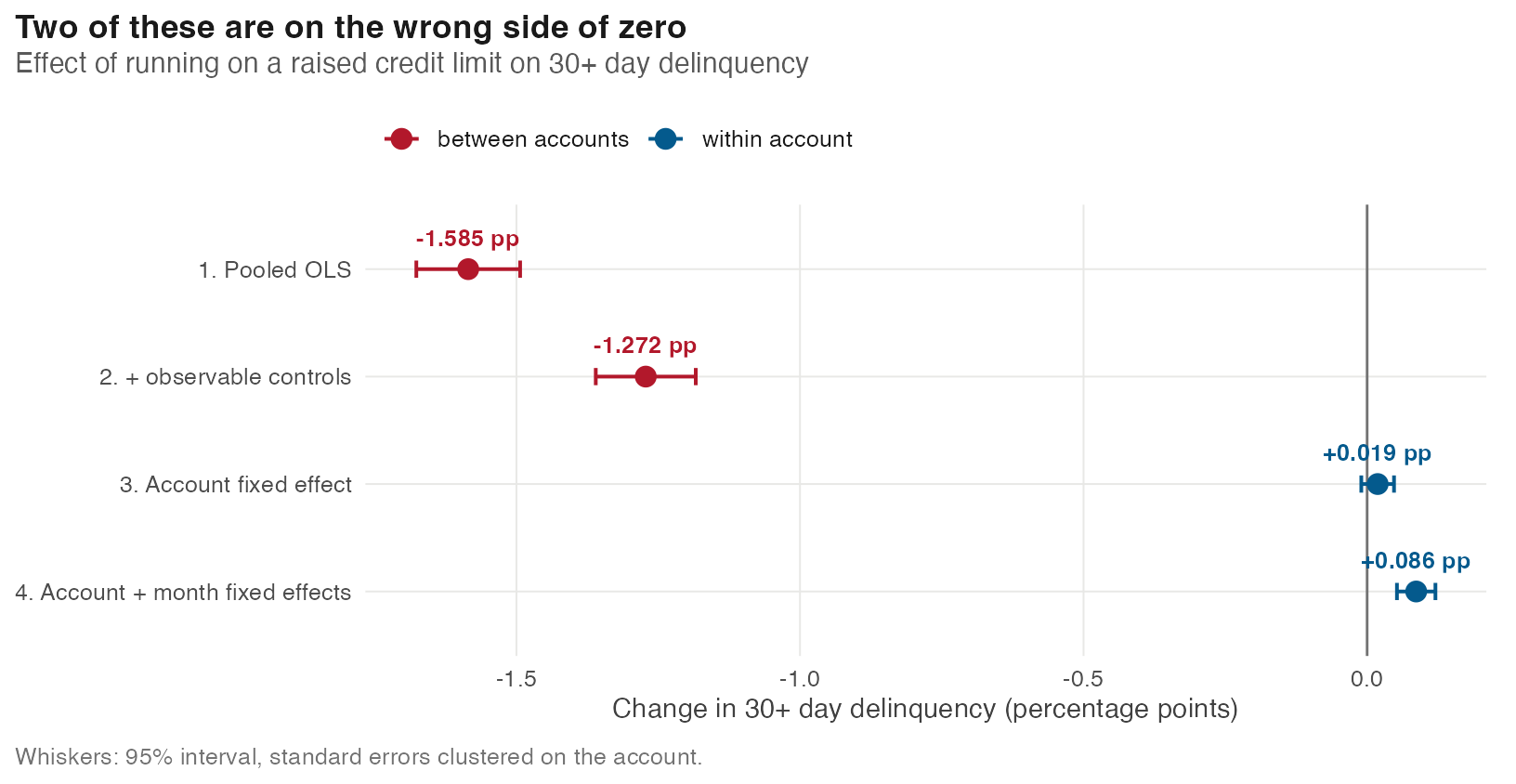
The question sounds like it needs one regression. It needs four, because the first three answer a different question than the one asked — and the first two answer it with the wrong sign.
| Estimate | t | Chapter | |
|---|---|---|---|
| Pooled OLS | -1.585 pp | -34.0 | The naive regression |
| + observable controls | -1.272 pp | -28.3 | Trying harder |
| Account fixed effect | +0.019 pp | 1.3 | Comparing an account with itself |
| Account + month fixed effects | +0.086 pp | 5.0 | What a month effect is |
Read the chapters in order. Each one fixes what the previous got wrong, and the last one is the answer. They are short — ten of them, a few minutes each.
The data is not redistributable, so it is not in the repository. R/00-download.R and R/01-build.R rebuild the exact panel from the competition files; everything here is reproducible from those two scripts.
The one sentence worth taking away
Model 1 is wrong by 1.67 pp and reports t = -34 while being wrong. Statistical significance measures how precisely you have estimated something. It says nothing about whether that something is what you wanted.
Where this chapter’s code lives
Everything above runs from index.qmd. Shared setup R/_common.R. The panel itself is built by R/01-build.R.